


Learn Around Nature (LAN)
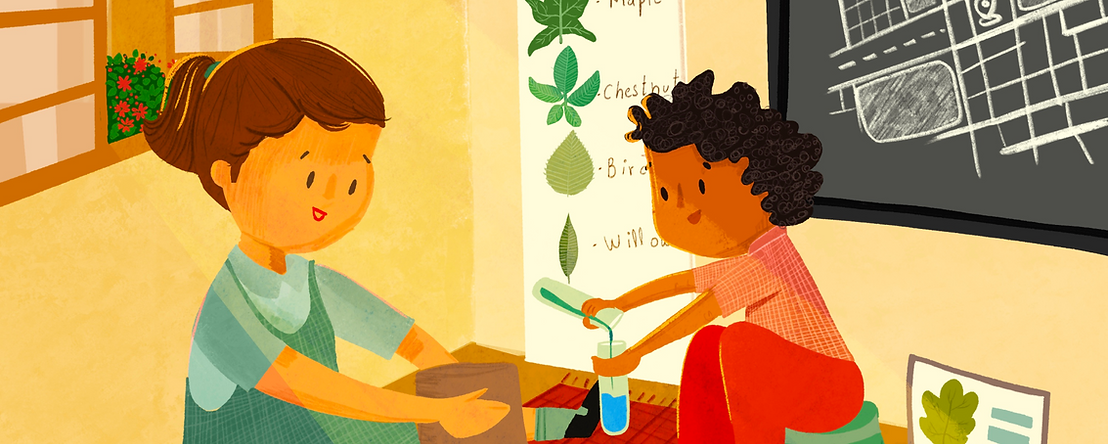
Learn Around Nature (LAN) is Thicket Tales' flagship place-based experiential learning programme for students in Grades 6–9 from low-income schools in Bengaluru, currently reaching approximately 180 students across three schools. The programme is designed as a year long learning journey, with students engaging for 180 minutes each week, using concepts from the NCERT Science and social science curriculum as a foundation. Rather than teaching these concepts solely through textbooks, LAN enables students to understand them through the landscapes, biodiversity, and communities around them, making learning relevant to their everyday lives.

.png)
.png)
.png)
Program Overview
LAN is a comprehensive educational initiative tailored for Karnataka-board secondary school students from low-income private schools and community centres currently serving government students. Spanning 10 months with 3 hours of weekly engagement, it integrates storytelling, arts, STEM activities, and interactive games to breathe life into 60% of the state syllabus's science and social science concepts.
How does it work?
LAN harnesses students' local environments as extensions of the classroom, using storytelling, outdoor explorations, scientific investigations, indoor experiments, games, discussions, arts-based activities, and collaborative learning experiences to build conceptual understanding.
The programme is organised into three thematic modules Landscape, Biodiversity, and Human Connection through which students progressively develop observation, inquiry, critical thinking, and systems thinking. Each module begins by helping students visualise curriculum concepts through their immediate surroundings before encouraging them to investigate, reflect, and apply their learning in authentic contexts.
The programme follows a three-year learning progression that deepens students' engagement with both their curriculum and their communities.
In Year 1, students connect curriculum concepts to their surroundings, identify neighbourhood challenges, and design place-based solutions.
In Year 2, they refine these ideas by working with communities and stakeholders while implementing meaningful community actions.
In Year 3, students lead, communicate, and scale their initiatives, gradually developing into confident environmental changemakers capable of influencing positive change within their communities.
Through this progression, LAN strengthens scientific inquiry, conceptual understanding, environmental stewardship, civic responsibility, collaboration, leadership, communication, and problem-solving while encouraging students to view science, geography, and social science as interconnected ways of understanding the world. The programme aligns with the National Education Policy (2020) and the National Curriculum Framework (2023) by promoting experiential, multidisciplinary, competency-based, and place-based learning. It also aligns with UNESCO's Education for Sustainable Development (ESD), SDG 4.7, the OECD Learning Compass 2030, and the Partnership for 21st Century Learning (P21) Framework, equipping learners with the knowledge, skills, values, and agency needed to contribute to more sustainable and resilient communities.
.png)
.png)
.png)
Student Success Trajectory

1.
Connection to Place
(Curriculum Visualization)
How it Happens?
Students visualise the curriculum using their immediate surroundings.They build understanding by observing and mapping their place.
Data Collection
-
Assessment every 4th episode (P21)
-
Episode-wise testing
-
Students document conceptual understanding
Data Collection
-
Assessment every 4th episode (P21)
-
Audit, survey, and inspection reports
-
Student reflections are documented and used as data
How it Happens?
Students reflect on local problems through guided activities. They analyse problems and visualise solutions.
Action Visualisation + Community Action
How it Happens?
Students translate ideas into small, real-world actions. They engage peers and the community to test solutions.
Data Collection
-
Assessment every 4th episode (P21)
-
Action documentation through photos and notes
-
Audit, survey, and inspection reports
3.
Action Visualisation (P&P) + Community Action + Change-Makers
How it Happens?
Students lead actions and communicate impact. They present solutions, reflect, refine, and plan next steps.
Data Collection
-
Final student reflection
-
Project portfolio / showcase
-
Baseline–Midline–Endline analysis
-
Action documentation
4.
2.
Place-Based Project
1.
Connection to Place (Curriculum
Visualization)
Year 1
Year 2
Year 3
"Akka... Everyone are throwing waste on the road."
"Here only vehicles are there on footpath!"
"Akka! That aunty threw waste there!"
"We found 3 open dumping spots in just one street."
"We don't have space to play inside school."
"This place is not used so can we use it as our playground?"
Grounded in Global Frameworks, Rooted in Local Places
National Education Policy (NEP 2020)
"Teaching and learning will be more interactive, with more creative, collaborative, exploratory activities for deeper and experiential learning."
How LAN brings this to life:
Students learn through neighbourhood explorations, field investigations, storytelling, discussions, and community projects instead of relying only on textbooks. Every episode is designed to make learning experiential, inquiry-driven, and multidisciplinary.
National Curriculum Framework (NCF 2023)
“Science is a dynamic body of knowledge that enables an understanding of the world around us through a process of inquiry. This process leads to acquisition of valid knowledge about the world, and of scientific values and capacities, such as formulating questions and hypotheses, inquiry, evidence-based thinking, creativity, understanding cause and effect relationships, and decision making.”
How LAN brings this to life:
Students observe local biodiversity, map neighbourhoods, investigate environmental issues, collect evidence, analyse data, and connect science and social science concepts with the places they experience every day.
UNESCO – Education for Sustainable Development (ESD 2030)
“Education for Sustainable Development empowers people with the knowledge, skills, values, attitudes and behaviors to live in a way that is good for the environment, economy, and society. It encourages people to make smart, responsible choices that help create a better future for everyone.”
How LAN brings this to life:
LAN develops systems thinking, futures thinking, critical reflection, and action competence by helping students understand how people and nature are connected, while encouraging them to design solutions for real environmental challenges in their communities.
United Nations Sustainable Development Goals (SDGs)
"Global goals begin with local action."
How LAN brings this to life:
Through projects on air, water, waste, biodiversity, green spaces, transport, and climate, students actively contribute towards SDGs 6, 11, 12, 13, 14, and 15, understanding that sustainable cities and healthy ecosystems begin in their own neighbourhoods.
OECD Learning Compass 2030
"Learners need the knowledge, skills, attitudes, and values to shape a better future."
How LAN brings this to life:
Students progress from observing local environments to analysing community challenges, collaborating with stakeholders, and taking informed action, building learner agency, systems thinking, and responsible decision-making.
Partnership for 21st Century Learning (P21)
"Preparing learners with the skills needed to thrive in the real world."
How LAN brings this to life:
Every LAN episode intentionally nurtures the 4Cs—Critical Thinking, Communication, Collaboration, and Creativity—while strengthening scientific inquiry, civic literacy, environmental stewardship, and student agency through authentic, place-based experiences.


.png)
_edited.png)
Contribute meaningfully
We aim to raise ₹25,00,000 to host LAN for 500 children in 2026.
Your impact - Your contribution will directly impact 3500 children, providing them with transformative experiences that will shape their understanding of the world and their role within it.
You can contribute in the following amounts that fuels our mission to create a brighter, more sustainable future through education and nature immersion.


+91 8072315106
+91 8618364259
Reports
Meet us there
.png)
.png)
.png)